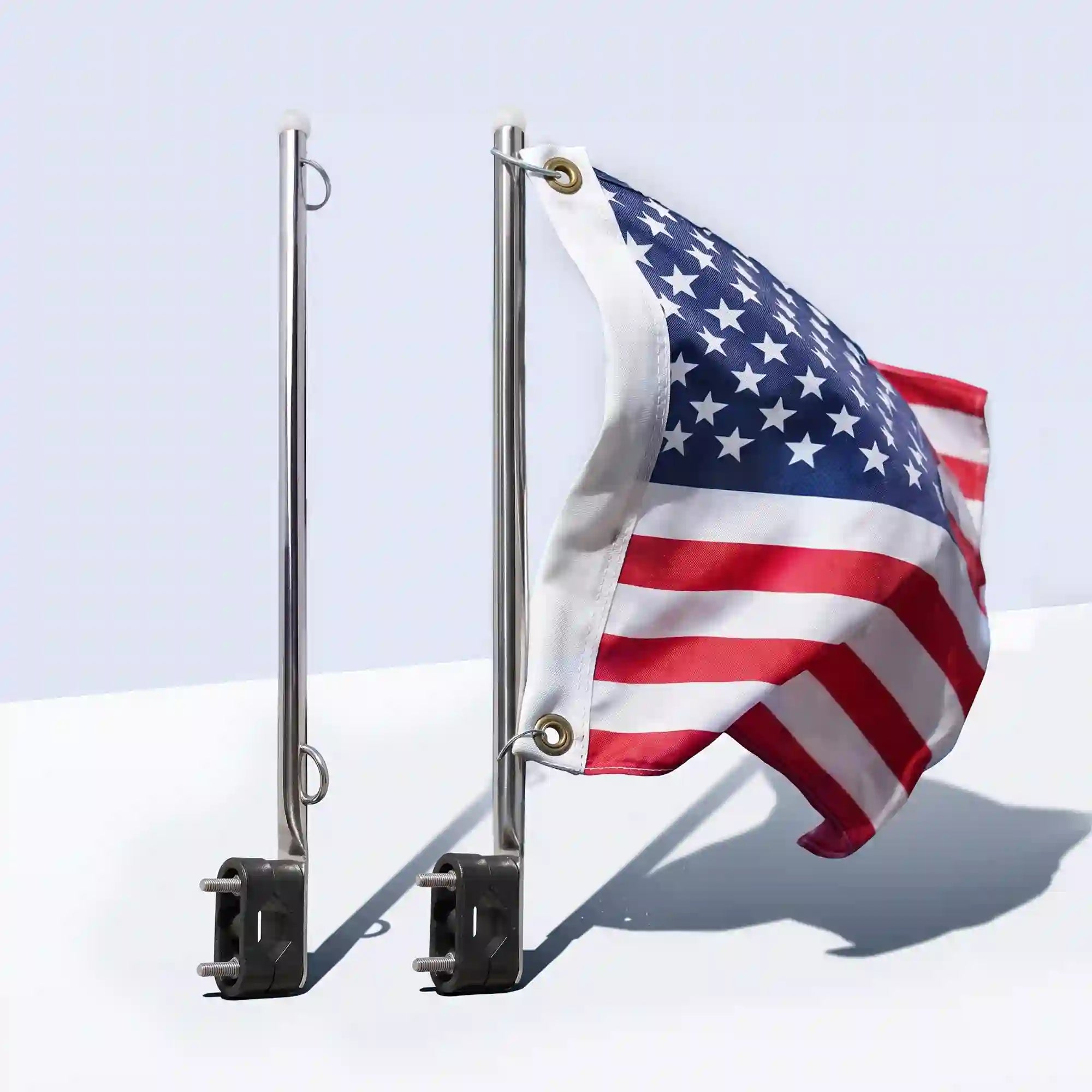
You put one foot on the lowest step, shift your weight, and the ladder moves away from the hull. For a moment, it is hard to tell whether the movement came from the mounting surface, the bracket, the hinge, or the ladder itself. An unstable boat ladder can result from loose mounting, poor bracket fit, insufficient hull support, worn moving parts, structural damage, or a setup that does not suit the boat.
Do not keep climbing while you try to identify the problem. Secure the boat, inspect the ladder without a person on it, and follow the instructions for the specific ladder and boat. If the mounting surface, welds, side rails, steps, or locking parts are damaged, stop using the ladder until it has been evaluated.
This guide focuses on rigid folding, telescoping, handrail, pontoon, and swim-platform ladders. It does not cover rope or emergency boarding ladders, which move differently under load.
When Should You Stop Using a Boat Ladder Immediately?
Stop using the ladder if any load-bearing part moves, bends, cracks, or fails to stay in its intended position. A cosmetic mark is different from a structural warning sign, but you should not test that difference by climbing again.
- The mounting bracket or mounting surface moves when the ladder is handled.
- There are cracks, crushed material, water intrusion, or enlarged holes around the mounting area.
- A weld, side rail, step, platform, or handrail is cracked or visibly deformed.
- The ladder cannot remain fully deployed or a locking feature will not engage.
- Fasteners are missing, badly corroded, pulling through the surface, or cannot be tightened correctly.
- The deployed ladder interferes with the engine, propeller area, trim hardware, or another part of the boat.
Do not rely on adhesive, an improvised spacer, or a generic hardware kit to compensate for a damaged structure. If you cannot inspect both the ladder and its mounting structure with confidence, ask the boat manufacturer or a qualified marine installer to evaluate the setup.
Quick Diagnosis: Where Is the Movement Coming From?

Watch one connection at a time while moving the unloaded ladder by hand. The first point that moves often identifies the area that needs closer inspection.
| What you notice | Likely area to inspect | Next action |
|---|---|---|
| The entire ladder and bracket move together | Mounting surface, backing support, or fasteners | Stop use and inspect the complete mounting structure |
| Movement is concentrated at a folding joint | Hinge, pivot, or deployed position | Check for incomplete deployment, wear, or deformation |
| Telescoping sections move sideways | Nested tubes, contamination, or damaged sections | Clean and inspect without forcing the tubes |
| A step sinks or a side rail changes shape | Load-bearing ladder structure | Stop use and evaluate replacement |
| The lower ladder moves toward or away from the hull | Hull standoff, support point, or fit | Check the deployed geometry and specified support points |
| The ladder is rigid but climbing still feels insecure | Step reach, tread grip, handholds, or clearance | Evaluate the entire reboarding path, not only the bracket |
During our review of public feedback for comparable boat ladders sold elsewhere, recurring complaints included short mounting bolts, misaligned holes, narrow steps, loose tread covers, and ladders that moved away from the hull under load. These reports do not describe Marinexplore products. They identify practical areas every boat owner should verify before installation and during inspection.
Why Does a Boat Ladder Wobble, Swing, or Flex?
1. The Fasteners or Mounting Surface Are Moving
If the bracket and ladder move as one unit, the problem is probably not inside the ladder. The movement may originate in a loose fastener, an enlarged hole, compressed deck material, inadequate backing support, hidden moisture damage, or a mounting surface that was never intended for the applied load.
Look at the upper and lower sides of the mounting area if both are accessible. Watch for a fastener head lifting, a washer sinking into the surface, a nut turning with the bolt, cracking around a hole, or movement between laminate layers. Do not assume that tightening harder will correct a weak or damaged mounting surface. Excessive tightening can crush some cored or composite structures.
The correct fastener material, diameter, length, backing arrangement, sealant, and tightening method depend on the ladder and boat construction. Use the ladder instructions and the boat manufacturer's requirements rather than a universal bolt recommendation.
2. The Bracket Does Not Sit Flat Against the Boat
A bracket that contacts the boat at only one edge can rock as the ladder is loaded. Common causes include a curved mounting surface, an uneven platform, sealant buildup, a deformed bracket, incorrectly positioned spacers, or holes that pull the bracket out of alignment.
With the ladder unloaded, inspect the complete perimeter of each bracket. A visible gap, changing contact point, or bracket that rocks before the fasteners are fully loose indicates a fit problem. Do not fill a structural gap with extra sealant and treat it as support. The bracket, any specified spacer, and the mounting surface must work together as the product instructions intend.
3. The Ladder Does Not Have the Support or Fit the Boat Requires
The upper attachment points hold the ladder to the boat, but the deployed ladder may also depend on its geometry or specified contact points to resist movement. If the lower section hangs too far from the hull, contacts a curved surface in the wrong place, or lacks the specified standoff, it can swing inward or outward as the user's weight shifts.
Fit problems can also begin with an incorrect mounting location. A ladder that works on a flat transom may behave differently on a rounded hull, a high-freeboard stern, or the edge of a narrow platform. Check the fully deployed ladder, its distance from the hull, foot clearance, and the path from the lowest usable step to the deck.
4. A Folding Hinge or Pivot Is Not Fully Deployed
Folding ladders need to reach their intended deployed position before use. A strap left under tension, an obstruction near the hinge, a bent pivot, corrosion, or an incorrectly installed bracket can prevent full movement. The ladder may look open while one joint remains partly folded.
Compare both sides of the ladder. Hinges should reach matching positions without binding or forcing. Some designs include normal operating clearance, so movement at a pivot is not automatically a defect. The warning sign is movement that has increased, is different from one side to the other, prevents full deployment, or is accompanied by wear, cracking, or deformation.
5. A Telescoping Section Is Not Fully Extended or Has Abnormal Play
Telescoping tubes can collect salt, sand, grit, and dried residue. Contamination may stop a section before it reaches its intended position. A dented tube or distorted overlap can also create uneven movement. Pull each section in the order specified by the manufacturer and confirm that the ladder reaches its full deployed length.
Do not force a stuck section with impact tools or climb on a partly extended ladder. Clean and inspect it first. For a detailed troubleshooting process, see Why Is My Boat Ladder Hard to Extend or Fold?
6. A Step, Side Rail, Handrail, Platform, or Weld Is Deformed
Structural damage changes how load travels through the ladder. A bent rail can make the steps sit unevenly. A cracked weld can allow movement that appears only when the ladder is pulled. A damaged platform can make an otherwise sound ladder feel unstable.
Inspect the structure in good light. Look for cracked weld lines, changes in tube shape, loose or rotating steps, sharp edges, separated tread covers, bent handrails, and platform distortion. Surface discoloration should be evaluated separately from pitting, cracking, or material loss. If a load-bearing part is damaged, stop using the ladder. Do not assume a general repair or universal replacement part will restore the original load path.
7. The Ladder Is Attached Firmly, but the Climb Still Feels Unstable
A ladder can be structurally attached and still provide a poor reboarding experience. The first usable step may be difficult to reach, the treads may not provide enough usable foot area, the ladder may sit too close to the hull for toe clearance, or the user may have no natural handhold during the transition to the deck.
BoatUS Foundation testing found that stability and boarding difficulty varied with ladder design, boat shape, freeboard, underwater step reach, and available support. This is why the full path matters, not just whether the fasteners feel tight. Review the BoatUS Foundation boarding ladder tests.
Evaluate the ladder from the waterline upward:
- Can the swimmer place a foot on the lowest usable step without an extreme knee lift?
- Do the treads provide usable grip when wet?
- Is there room for fingers and toes between the ladder and the boat?
- Is there a natural handhold before the user transfers onto the deck?
- Is the landing area clear of seats, gates, lines, and other obstacles?
What Causes Instability in Different Types of Boat Ladders?
The same symptom can point to different components depending on the ladder design. Use these checks as a starting point, then follow the instructions for the exact model.
Folding Boat Ladders
Check whether both folding sides reach the same deployed position. Inspect pivot points, hinge plates, storage straps, handrails, and any point where the folded ladder might contact the boat. Uneven deployment can make the lower steps sit at an angle even when the mounting bracket is secure.
Telescoping Boat Ladders
Confirm that every nested section is fully extended and aligned. Compare the left and right rails, inspect for dents or residue, and look for a section that stops earlier than the matching side. If the ladder is difficult to extend, solve that problem before evaluating it under load.
Boat Ladders With Handrails
Inspect the handrail connection as part of the load path. A loose handrail can make the entire climb feel unstable even when the steps are secure. Confirm that the user's natural pull on the handrail does not twist the mounting bracket or mounting surface.
Pontoon Boat Ladders
Check the deck connection, bracket fit, deployed angle, handrail stability, and clearance around the gate or boarding area. Confirm that the ladder is secured in its stored position before the boat moves. A pontoon ladder should not depend on a loose gate, rail, or unsupported trim panel for its primary attachment.
Swim-Platform Boat Ladders
Inspect the platform before blaming the ladder. Check the platform-to-boat connection, platform surface, ladder bracket, handhold, and deployed clearance. Movement in the platform can be transmitted through the ladder and feel like a loose hinge or rail.
Should You Keep Inspecting the Ladder or Replace It?
Maintenance may solve contamination or a storage problem. Structural damage, persistent mounting movement, or a poor fit usually requires a different response.
| Condition | Practical next step |
|---|---|
| Salt, sand, or residue prevents smooth extension | Clean and inspect according to the product instructions before retesting |
| A storage strap or retaining method is incorrect | Correct the stowed configuration using the model instructions |
| Fastener condition is uncertain but the structure is not visibly damaged | Have the model-specific mounting system and boat structure evaluated |
| A rail, step, handrail, bracket, platform, or weld is bent or cracked | Stop use and evaluate complete ladder replacement |
| Mounting holes continue to enlarge or the mounting surface flexes | Stop use and have the boat structure professionally assessed |
| The ladder cannot provide suitable reach, support, or clearance on the boat | Measure again and choose a ladder type that fits the complete reboarding path |
Marinexplore does not sell or guarantee universal replacement hardware for every boat ladder. If a model-specific component is required, contact the original ladder manufacturer. Do not assume that a part with similar dimensions has the same material, geometry, or load rating.
If the Ladder Must Be Replaced, Choose by the Problem You Found
Do not buy the same step count automatically. Record the old ladder's mounting location, bracket spacing, available mounting area, fully deployed reach, hull clearance, handhold position, storage envelope, and the specific reason the old setup felt unstable.
- No confident handhold: Compare a ladder with integrated handrails, but verify the rail's mounting and surrounding clearance.
- The lowest step is hard to reach: Measure from the intended mounting surface to the waterline and compare fully deployed length.
- The ladder does not stow cleanly: Compare folding and telescoping arrangements within the available storage space.
- The platform moves or provides a poor transition: Inspect the platform structure and evaluate whether a swim-platform ladder arrangement suits the boat.
- The bracket does not fit the mounting surface: Resolve the mounting geometry before choosing another ladder. Step count alone will not correct poor bracket contact.
For a complete sizing and type comparison, read How to Choose a Boat Ladder: Types, Size & Fit. When the mounting location is confirmed, use How to Install a Boat Ladder to plan the installation checks.
Boat Ladder Stability Checklist
Complete this inspection with the boat secured and the ladder unloaded. Follow the model instructions for any final test.
- Inspect the mounting surface for cracks, flexing, crushing, enlarged holes, or water intrusion.
- Confirm each bracket sits correctly against the intended mounting surface.
- Check all specified fasteners, washers, backing support, and retaining parts.
- Deploy every hinge or telescoping section fully without forcing it.
- Inspect steps, side rails, handrails, welds, treads, and the platform for damage.
- Check the ladder's distance from the hull and available finger and toe clearance.
- Confirm clearance from propulsion equipment and other moving parts.
- Verify the path from the lowest usable step to a secure handhold and clear deck landing.
- Use only the inspection or testing procedure specified for the ladder and boat.
Frequently Asked Questions
Is some movement normal in a boat ladder?
It depends on the design. A folding or telescoping joint may have some operating clearance, but the mounting surface, structural rails, steps, and deployed position should not show unexpected movement. Compare both sides, check the model instructions, and stop use if movement has increased or is accompanied by wear, cracking, or deformation.
Why does my boat ladder swing away from the hull?
The deployed geometry may not provide the intended hull support, the standoff may be missing or incorrectly positioned, the bracket may not fit the mounting surface, or the ladder may not suit the hull shape. Check the specified contact points and clearances rather than adding an improvised spacer.
Can loose mounting bolts make a boat ladder unsafe?
Yes. Loose or moving fasteners can shift load into a smaller part of the bracket or boat structure. The underlying cause may also be an enlarged hole, compressed mounting material, damaged backing support, or an incorrectly sized fastener. Do not simply tighten harder without identifying why the connection moved.
Why does a telescoping boat ladder wobble?
A section may be partly extended, contaminated with salt or grit, dented, misaligned, or worn. Inspect the nested tubes unloaded, compare both rails, and follow the manufacturer's extension order. Do not climb on a ladder that cannot reach and maintain its intended deployed position.
Can corrosion make a boat ladder unstable?
Corrosion can affect fasteners, pivots, weld areas, and tubes. Light surface staining is different from pitting, material loss, cracking, or a seized joint. Clean and inspect the area closely. If corrosion has changed a load-bearing part or prevents correct operation, stop using the ladder.
Should I repair or replace a bent boat ladder?
A bent load-bearing rail, step, bracket, handrail, or platform is a structural warning sign. Stop using the ladder and consult the original manufacturer or a qualified marine professional. Replacing the complete ladder may be more appropriate than attempting an unverified repair that changes the original load path.
Why does the ladder feel stable at the dock but unstable in the water?
In the water, the user approaches from below, the boat moves, and the force shifts as each step is climbed. A first step that is difficult to reach, insufficient hull support, poor handhold placement, or limited toe clearance may not be obvious during a dockside inspection.
Do wider steps make a boat ladder feel more stable?
Wider usable tread area and wet-grip surfaces can improve foot placement, but they do not correct a loose bracket, damaged mounting surface, bent rail, or poor ladder fit. Treat tread comfort and structural stability as separate checks.
Can I use universal replacement hardware on a boat ladder?
Do not assume that universal hardware is suitable. Matching appearance or thread size does not confirm material, length, strength, backing requirements, or compatibility with the ladder and boat. Use model-specific instructions and contact the original manufacturer when replacement hardware is required.
How often should I inspect a boat ladder?
Inspect it before seasonal use, after installation or adjustment, after an impact or unusual load, and whenever movement, corrosion, binding, or damage appears. The product instructions and boat use conditions may require additional checks.
Find the First Point That Moves
An unstable boat ladder is not one diagnosis. Start at the boat structure, then follow the load path through the brackets, fasteners, hinges or telescoping sections, rails, steps, handrails, and the user's transition to the deck. The first unexpected movement usually tells you where to investigate next.
If the current ladder is damaged or does not fit the boat's reboarding path, compare mounting styles, deployed reach, step count, handholds, and storage requirements in the Marinexplore Boat Ladders collection. Measure first, follow the model instructions, and do not use the ladder until the complete system is secure.